
Criminal Court Cases in Worth County
The Worth County Clerk of District Court keeps the local criminal case file at 1000 Central Avenue in Northwood. Worth County is part of Judicial District 2A. District judges hear felonies and indictable misdemeanors. Magistrates commonly handle simple misdemeanors, initial appearances, and other preliminary work. Traffic and city ordinance matters that are filed in court also enter Iowa's unified judicial system. Northwood, Manly, and Kensett do not run a separate broad municipal-court docket.
The Worth County Attorney files prosecutions for the State of Iowa. The clerk then records the complaint or trial information, appearances, pleas, motions, orders, hearings, judgment, sentence, and financial entries. This division of work matters. The sheriff may hold an arrest report, but the Worth County court file shows what the prosecutor filed and what the judge decided. Older, confidential, or non-digitized material may require a direct clerk request even when the courthouse and sheriff share the same address.
Iowa Courts Search for Worth Cases
Iowa Courts Online is the public statewide index for a Worth County criminal case search. Select trial court search and County = Worth when the event is known to be local. A name search helps when the case ID is unknown. A 17-character, uppercase case ID is more precise when it is available. Search traffic separately if a stop may have led to both a criminal charge and a traffic filing.
The image from the official Iowa Courts Online portal shows the interface Worth County readers use before opening a matching docket.
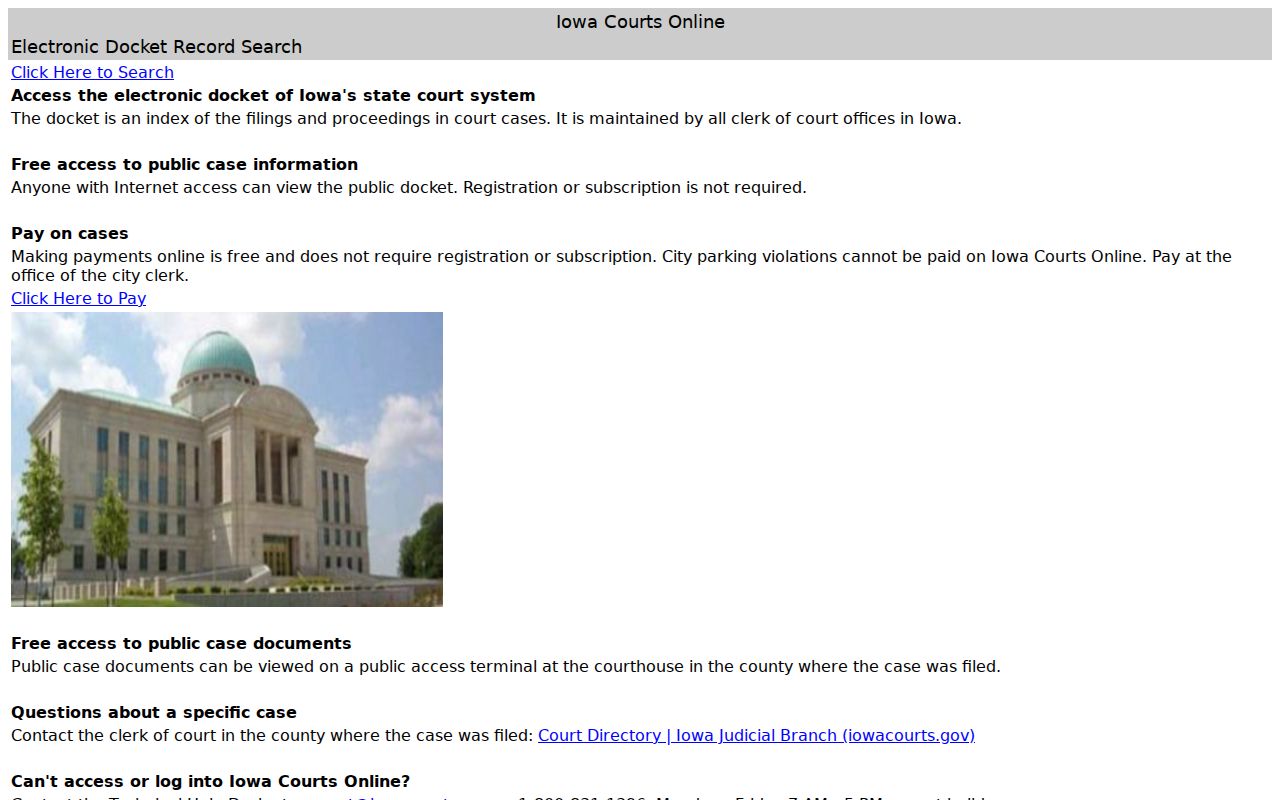
The portal is an index, not the official record itself. A result can identify a case and its events while still requiring the Worth County clerk for the underlying order or certified copy.
Worth County Case Record Searches
Use stable identifiers and confirm the county before relying on a match. A common name can produce unrelated Iowa cases. The portal's official help supports name, date-of-birth, case-ID, and citation routes. A date-of-birth search requires the first name, last name, and exact birth date. For a name search, add the middle name when known and compare the case type and party details that are lawfully displayed.
- Open Iowa Courts Online and choose the trial court route.
- Select Worth County, then enter a party name, case ID, or citation number.
- Narrow by case type and compare the middle name or birth information shown.
- Open the docket and read each charge, event, status, and disposition separately.
- Ask the Worth County clerk for an unavailable filing, official copy, or certified judgment.
The core controls documented by Iowa's court-search help are set out below. A field may be optional in one search route and required in another.
| Field Label | Type | Required | Notes |
|---|---|---|---|
| County | Dropdown | Optional/narrowing | Select Worth for a local filing |
| First and Last Name | Text | Route-dependent | DOB search needs exact first and last name |
| Date of Birth | Date | For DOB route | Exact date required |
| Case ID | Text | Optional | 17 characters; letters uppercase |
| Case Type | Dropdown | Optional | Use criminal or traffic as appropriate |
| Citation Number | Text | Optional | Full or partial entry depends on route |
Worth Case IDs and Filing Gaps
An absent Worth County result does not always mean no case exists. A citation appears only after it is filed with the county clerk, and the payment search warns that filing can take 14 to 21 days. Try spelling variants, check for a hyphen or apostrophe, search traffic as well as criminal cases, and confirm that the event was not filed in another county. City parking matters are a notable exception because they may remain with City Hall rather than enter the state court payment path.
Technical errors call for a different response. Iowa Courts Online lists system help at 1-800-831-1396, Monday through Friday, 7 a.m. to 5 p.m. except holidays. That line can address portal use, but it cannot interpret a Worth County charge or give legal advice. For the record itself, call the clerk at 641-324-6539. The scheduling contact at 641-494-3612 is not the general copy counter.
Note: A missing online result may reflect filing lag, search syntax, another county, or a citation that was never filed.
What a Criminal Case File Contains
A Worth County case file is organized around the prosecution, not the jail intake. The header identifies the Iowa case ID, title, county, court or case type, filing date, and status. Party rows identify the State of Iowa, defendant, and attorneys of record. Charge rows may show the code section, offense class, alleged offense date, and charge-level disposition. Event and hearing entries document how the case moved.
| Case ID & Court | Worth County, case type, filing sequence, title, and status |
|---|---|
| Charging Document | Complaint, trial information, or indictment when used |
| Docket Entries | Appearances, pleas, motions, orders, warrants when public, and closure |
| Hearing Dates | Date, time, event type, location, and judicial officer when shown |
| Disposition & Judgment | Outcome for each charge and the court's judgment |
| Sentence & Financials | Sentence, fine, surcharge, costs, restitution, and payment status where exposed |
Some docket entries have no free public PDF. Sensitive addresses, full birth dates, Social Security numbers, victim information, juvenile data, and confidential investigative facts are not necessarily public. The clerk can explain copy methods, but only the court can decide whether a restricted filing may be released.
Worth Clerk Copies and Terminals
Online convenience and document access are not the same. Iowa's free docket search gives a public index. Advanced Case Search costs $25 per month and adds fields for docket, party, judgment or lien, exhibit, financial, service, traffic, case type, and schedules, but it does not add document images. For a specific Worth County filing, the free courthouse terminal or a focused request to the clerk may be more useful than a paid metadata account.
Give the clerk the case ID, document title or event date, number of copies, and whether certification is needed. Ask for the current copy and certification price because no verified Worth County fee schedule was published in the research. For an older or non-digitized file, request a search by exact name and approximate year. The same approach applies when the online docket lists an order but does not expose it.
The Iowa State Public Defender page shown below explains the separate appointed-counsel system, not a public record-search service.
A person seeking appointed counsel applies through the court after financial review; a reader seeking a docket copy stays with the Worth County clerk.
Criminal Case Stages in Worth County
A Worth County case begins when a complaint, trial information, or indictment is filed. An initial appearance addresses the charge and release conditions. Arraignment is the formal plea stage. Pretrial work can include discovery, motions, negotiations, and hearings. The matter then resolves by plea, dismissal, acquittal, or verdict. Judgment and sentencing follow a conviction, while later entries may concern payment, appeal, probation, or a warrant.
Case flow: Charges Filed › Arraignment › Pretrial › Plea or Trial › Disposition › Sentencing
The arrest label and trial information may differ because the Worth County Attorney reviews the evidence and chooses what to file. Charges can also be amended. Read the final charge-level disposition instead of assuming that the first allegation remained unchanged. For the custody event that came before filing, the separate Worth County arrest search explains the sheriff and jail record.
Worth Charges, Outcomes, and Financial Entries
Three lines often get confused in a Worth County docket. A charge describes the alleged offense. A disposition records how that charge ended. A financial entry tracks fines, surcharges, costs, restitution, or payments. A case can be disposed while money remains due. Likewise, payment does not turn a dismissal into a conviction or explain the court's ruling.
- Trial information
- The Iowa prosecutor's formal felony or indictable-misdemeanor charging document.
- Disposition
- The result for a charge, such as conviction, dismissal, acquittal, or another stated outcome.
- Deferred judgment
- A judgment withheld while court-ordered terms are completed; it is not the same as expungement.
- Sentence
- The consequence ordered after a judgment of guilt.
- Satisfaction
- An entry showing that a stated obligation has been met, not a new case outcome.
A disposed case does not become confidential merely because it ended. Iowa Code chapter 901C supplies separate rules for qualifying dismissals, acquittals, and a narrow group of misdemeanor convictions. Relief must be granted through the court process.
Access Rules for Case Records
Iowa court access begins with a presumption of public records, but access has limits. Iowa Code chapter 22 protects examination and copy rights while section 22.7 identifies confidential categories. Court rules and online policy also govern electronic access. An online index is not a promise that each filing is downloadable.
Juvenile material is generally confidential under section 232.147. Expunged files become confidential under chapter 901C. Protected victim information, Social Security numbers, full birth dates, sealed documents, and some investigative facts may be withheld or redacted. A public docket entry can therefore be visible even when its attachment is not. Ask the Worth County clerk about the record, not the sheriff, when the missing item was filed in court.
Worth Criminal Dockets and Confidentiality
A dismissal and an expungement are different events. Dismissal is the case outcome. Expungement under Iowa Code chapter 901C is a separate order that makes a qualifying file confidential. Iowa law covers qualifying dismissals and acquittals, plus a limited one-time route for eligible misdemeanor convictions after statutory conditions are met. Deferred judgment is another distinct term and should not be used as a synonym for either result.
If a qualifying Worth County record should be confidential, file through the Iowa District Court case and use the current Judicial Branch forms. After an order, check the public docket and a DCI self-review. If the record still appears, send the order and precise discrepancy to the custodian through its official method. Neither the portal's overall status nor a paid balance proves that confidentiality has taken effect.
Note: Confirm a restriction with the Worth County clerk because a docket label alone does not establish that every related record is confidential.